I.M. Pei
Mid-Century Modern Architect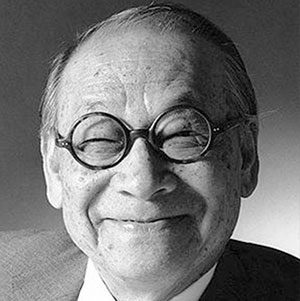
When Ieoh Ming Pei left Canton, China for the United States in 1935, his American journey began in Philadelphia. The 17-year-old enrolled at the University of Pennsylvania to study architecture, but Penn’s strict adherence to Beaux-Arts tradition didn’t suit a young man already drawn to modernism. Within weeks he transferred to MIT, where he earned his Bachelor of Architecture in 1940, then completed a Master of Architecture at the Harvard Graduate School of Design in 1946 under Bauhaus founder Walter Gropius and Marcel Breuer. After contributing to the National Defense Research Committee during World War II and teaching briefly at Harvard, Pei spent twelve years as the in-house architect for New York developer William Zeckendorf before launching his own firm in 1955 — the practice that ultimately became Pei Cobb Freed & Partners.
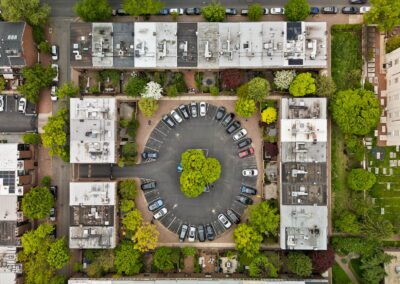
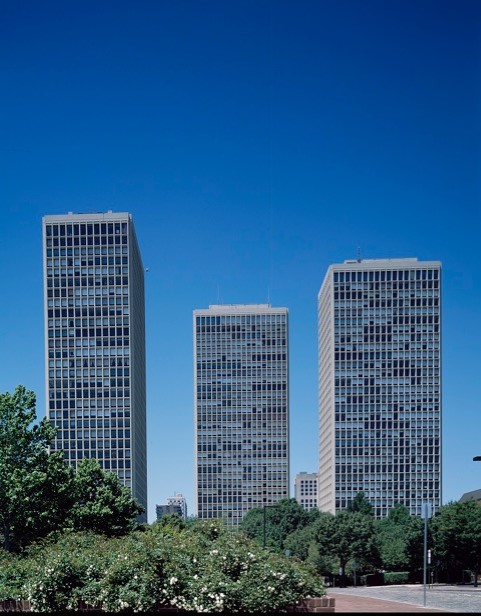
Pei returned to Philadelphia in spectacular fashion in the early 1960s. As part of city planner Edmund Bacon’s bold renewal of Society Hill — then a deteriorated quarter near the old Dock Street produce market — Pei was selected through an invited developer-architect competition that paired him with Zeckendorf’s Webb & Knapp. Rejecting the brief’s call for low twelve-story slabs, he proposed something far more ambitious: three slender 31-story towers, pinwheeling around a central plaza so that each opened to its own view corridor across the historic neighborhood. Completed in 1964, the Society Hill Towers rose in cast-in-place concrete, their 624 apartments wrapped in a crisp grid of floor-to-ceiling windows. At their feet, 37 brick townhouses — also Pei’s design — knit the modern complex into the eighteenth- and nineteenth-century streetscape around it. The project earned a 1961 Progressive Architecture Award and a 1965 AIA Honor Award, and in 2000 the American Concrete Institute’s Delaware Valley Chapter recognized it with the 25-Year Award for Architectural Excellence. Six decades on, the towers remain one of the defining silhouettes of the Philadelphia skyline.
Pei’s firm continued to shape the city for decades. The twin 41-story granite-clad towers of Commerce Square rose on West Market Street in 1987 and 1992, their cut-out diamond crowns the work of design partner Henry N. Cobb. Pei Cobb Freed also designed the National Constitution Center (2003) at the north end of Independence Mall and the 80,000-square-foot Edmund D. Bossone Research Enterprise Center at Drexel University (2005).
Beyond Philadelphia, Pei’s portfolio reads like a primer on the great civic and cultural buildings of the twentieth century: the East Building of the National Gallery of Art in Washington, D.C. (1978); the John F. Kennedy Presidential Library in Boston (1979); the glass Pyramid at the Louvre in Paris (1989); the soaring Bank of China Tower in Hong Kong (1990); the Rock and Roll Hall of Fame in Cleveland (1995); and the Museum of Islamic Art in Doha, Qatar (2008). His honors include the AIA Gold Medal (1979), the Pritzker Architecture Prize (1983) — the field’s highest distinction — and the Presidential Medal of Freedom (1992).
I.M. Pei died on May 16, 2019, at the age of 102. His Philadelphia work, which began with that improbable arrival at Penn nearly nine decades earlier, anchors a global legacy of buildings that joined modern conviction with a deep respect for context, history, and place.
Society Hills Towers