Emil A Schmidlin
Mid-Century Modern Architect
Architect Emil Schmidlin
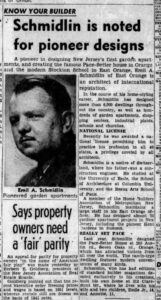
Emil A. Schmidlin was a pioneering modernist architect whose innovative designs helped define postwar American residential architecture, particularly in the Northeast. Born in Switzerland around 1907, Schmidlin immigrated to the United States and established a prolific career in New Jersey, where he supervised his East Orange-based firm for over 50 years. A member of the American Institute of Architects (AIA) New Jersey Chapter since 1949, he began his practice in partnership with Eugene A. McMurray before going independent in 1945. Schmidlin’s work emphasized livable modernism—blending clean lines, functional innovation, and integration with the environment—to create homes that were both forward-thinking and practical for everyday family life.
Schmidlin’s architectural philosophy centered on experimentation and adaptability, drawing from the optimism of mid-century design. He was an early adopter of new materials and technologies, designing some of the first garden apartments and split-level homes in New Jersey. His collaborations, notably with designer Ellis Leigh, extended to landmark projects that showcased innovative interiors and detailing. These partnerships reflected a spirit of progress, as seen in their joint work on the Formica House at the 1964 New York World’s Fair—a futuristic model home that highlighted durable, modern materials like laminated plastics for both exteriors and interiors.
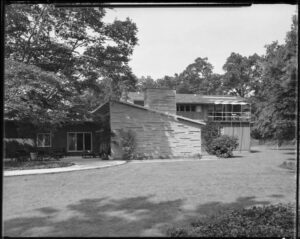
Throughout his career, Schmidlin designed a wide range of structures, including schools, public buildings, and commercial spaces across the United States. However, his residential works stand out for their emphasis on climate control, natural light, and seamless indoor-outdoor connections. Projects like the 1949 Pace Setter House for House Beautiful magazine exemplified his approach, featuring advanced features such as underground snow-melting systems and an “X-marks-the-spot” layout that organized spaces around a central hub. This home, part of House Beautiful’s Pace Setter Program, promoted a “livable” alternative to rigid international modernism, influenced by organic principles and tailored to American lifestyles.
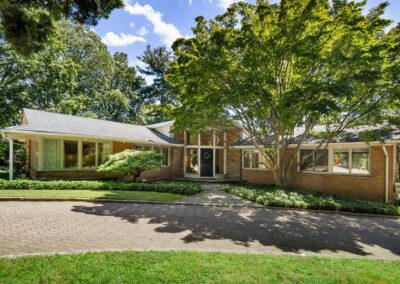
Schmidlin’s designs often integrated site-specific elements, such as landscapes and natural surroundings, to enhance comfort and functionality. His 1957 Green Acres estate in Wyncote, Pennsylvania, embodies this ethos, with its circular foyer, expansive glass walls, and thoughtful positioning to capture sunlight throughout the day. Backed by nearly two acres adjoining the Curtis Arboretum, it balances mid-century authenticity with modern updates, making it a timeless example of his vision.
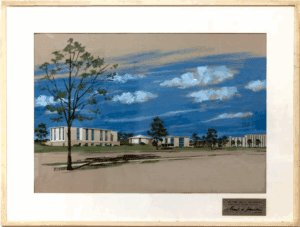
Beyond residential architecture, Schmidlin contributed to institutional projects, including modernist buildings at Seton Hall University. He passed away on March 4, 1988, at age 81, leaving a legacy of thoughtful, human-centered design that continues to inspire. Survived by his wife Veronica, brothers Walter and Karl, daughter Annette DeBona, son Emil Jr., and grandchildren, Schmidlin’s work endures as a testament to the enduring appeal of mid-century modernism—practical, innovative, and deeply connected to the American dream.
Notable Projects
– Garden Apartments, Summit, NJ (1940): One of Schmidlin’s early collaborations with Eugene A. McMurray, this 25-building complex introduced garden-style living to suburban New Jersey, emphasizing communal green spaces and efficient layouts.
– Pace Setter House, Orange, NJ (1949): A model home for House Beautiful’s Pace Setter Program, featuring climate-control innovations, snow-melting wiring, and a hub-and-spoke layout that influenced postwar residential design.
– Wing Haven, New Vernon, NJ (1953): Residential design incorporating landscape elements by Alice L. Dustan, highlighting Schmidlin’s focus on integrating architecture with natural settings.
– Green Acres, Wyncote, PA (1957): A mid-century modern estate with interiors by Ellis Leigh, known for its circular foyer, terrazzo floors, walnut paneling, and seamless connection to the surrounding arboretum.
– Formica World’s Fair House, New York, NY (1964): Collaborating with Ellis Leigh, this seven-room model home at the World’s Fair showcased Formica laminates on exteriors and interiors, including skylights, a patio, and an indoor barbecue—promoting affordable, low-maintenance modern living.
– Seton Hall University Buildings, South Orange, NJ (Date Unknown): Modernist campus structures depicted in firm renderings, demonstrating Schmidlin’s versatility in institutional design.
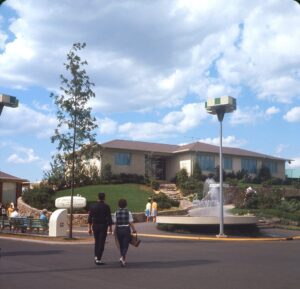
Formica House
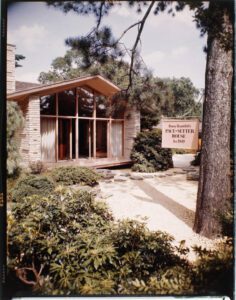
“House Beautiful” Pace Setter House 1959